16 Jul Vicksburg, MS
This post is based primarily on Don's notes, occasionally supplemented with MT's notes from our cruise in July 2025. When information from other sources is added—for further explanation to readers or to satisfy our own curiosity—that is set off in a text box (as this one).
Most of the photos that accompany this post are from Don’s camera (with a caption indicating the time it was taken); those from MT’s iPhone are indicated by “MT” placed at the beginning of the photo caption. Photos from any other source (such as the public domain Wikimedia Commons), occasionally used for clarification, indicate that source in the caption.
Most of the photos that accompany this post are from Don’s camera (with a caption indicating the time it was taken); those from MT’s iPhone are indicated by “MT” placed at the beginning of the photo caption. Photos from any other source (such as the public domain Wikimedia Commons), occasionally used for clarification, indicate that source in the caption.
The Viking Daily newsletter showed today's weather forecast as "Mostly Sunny 94° F" and "Sunrise: 6:07 AM | Sunset: 8:11 PM."
Don woke at 6:15 am (MT already up).
At 7:30, we went to the River Café (Deck 5) for breakfast.
The Viking Daily newsletter said we were scheduled to dock in Vicksburg, Mississippi at 8:00 am, but we got there around 7:30.
Vicksburg,
Mississippi is a city (pop. 21,573) in western
Mississippi, located on a high bluff on the east bank of the Mississippi River across
from Louisiana. The first Europeans to
settle in the area were French colonists, who built an outpost here in 1719. In
1825, it was incorporated as Vicksburg, named for Methodist missionary Newitt
Vick. During the Civil War, it was a key Confederate riverport until it was
surrendered to Ulysses S. Grant in July 1863. That, along with the concurrent Battle
of Gettysburg marked a turning point of the war. Vicksburg is known as the site
of a key Civil War battle. The Siege of Vicksburg is commemorated at the vast
Vicksburg National Military Park, which encompasses the Vicksburg National
Cemetery and the restored USS Cairo gunboat.

Wednesday, July 16, 2025, 7:34 AM - Vicksburg: view, from ship, of Mulberry Vicksburg apartment buildings near the dock.
The
Mulberry Vicksburg is an amenity-heavy apartment complex housed in the buildings
formerly occupied by Jimmy Buffet’s Margaritaville Hotel and Harrah’s Casino on
Mulberry Street in Vicksburg.

7:35 AM - Vicksburg: view, from ship, of tops of downtown buildings, to left of Mulberry Vicksburg, at far right (telephoto 93 mm and Cropped).

7:53 AM - Vicksburg: view, from ship, of tops of downtown buildings (left) and Mulberry Vicksburg (right).

7:37 AM - Vicksburg: view, from ship, of part of Mulberry Vicksburg (telephoto 93 mm ).
At 9:00, we went to the Living Room (Deck 1) meeting place for the 9:15 shore excursion "Vicksburg National Military Park."
Vicksburg
National Military Park, established in 1899, preserves the
site of the Civil War Battle of Vicksburg, waged from March 29 to July 4, 1863.
The park, flanking the Mississippi River, also commemorates the greater
Vicksburg Campaign, which led up to the battle. The park includes 1,325 historic
monuments and markers, 20 miles of historic trenches and earthworks, a 16-mile
tour road, two antebellum homes, 1344 emplaced cannons, the restored gunboat
USS Cairo (sunk on December 12, 1862, on the Yazoo River).
The 116.28-acre Vicksburg National Cemetery is within the park. It has 18,244 interments (12,954 unidentified), made in 1866-1874.
The 116.28-acre Vicksburg National Cemetery is within the park. It has 18,244 interments (12,954 unidentified), made in 1866-1874.
As our bus entered the park's tour road, we saw several of the Ohio Memorials. We could see many of them from our seats on the right side of the bus.
The
Ohio Memorials are along the tour road near the entrance to the park. 39
memorials and 20 markers denote the positions regiments held and where 11,984
Ohioans served throughout the Siege of Vicksburg.

9:32 AM - Vicksburg National Military Park: view, from bus window, of memorial for Ohio Eighty-Third Infantry Regiment, with greyhound above "Ohio" at the base.
The
Ohio Eighty-Third Infantry Regiment of the Union Army was nicknamed “The
Greyhound Regiment.” Its official name is near the top of the monument, and a
greyhound is depicted above the word “Ohio” on the base.
For a clearer photo of the monument from the National Park Service, see https://www.nps.gov/vick/learn/historyculture/83rd-ohio-infantry.htm .
For a clearer photo of the monument from the National Park Service, see https://www.nps.gov/vick/learn/historyculture/83rd-ohio-infantry.htm .

9:33 AM - Vicksburg National Cemetery: view, from bus window, of memorial for Ohio Fifty-Eighth Infantry Regiment (overexposed).
.jpg)
Vicksburg National Military Park: Ohio Fifty-Eighth Infantry
monument (By Dsdugan - Own work, CC0, at https://commons.wikimedia.org/w/index.php?curid=127013748).

MT 9:30 AM -Vicksburg National Military Park: Minnesota state memorial, with statue of Peace at base.
.jpg)
Vicksburg National Military Park: statue of Peace at base of Minnesota State Memorial (By Judson McCranie, CC BY-SA 3.0, https://commons.wikimedia.org/w/index.php?curid=83463495).
The Minnesota State Memorial honors troops from Minnesota that participated in the Vicksburg campaign. Dedicated in 1907, it features a 90-ft tall white granite column. At the base of the column is a raised bronze statue of a woman representing the “Statue of Peace.” She is seen holding a sword and a shield from both armies who have placed their weapons in her keeping.

9:38 AM -Vicksburg National Military Park: memorial for Iowa Third Brigade, First Division, Fifth Corps, with "Iowa" above columns.
.jpg)
Vicksburg National Military Park: memorial for Iowa Third Brigade, First Division, Fifth Corps, with "Iowa "above columns and "3rd Brig, 1st Div., 5th Corps" below columns (By Gary Todd at https://commons.wikimedia.org/wiki/File:Vicksburg_National_Military_Park,_Iowa_Monument,_3rd_Brig.,_1st_Div.,_5th._Corps_(10473590354).

9:38 AM -Vicksburg National Military Park: area with trenches and Illinois Memorial on the far horizon.

9:39 AM -Vicksburg National Military Park: unidentified memorial with Illinois Memorial on the far horizon.

9:40 AM -Vicksburg National Military Park: a row of cannons.

MT 9:34 AM -Vicksburg National Military Park: view ahead to Illinois Monument.

9:53 AM -Vicksburg National Military Park: Illinois Memorial.
The
Illinois Memorial (also known as the Illinois State Memorial),
dedicated in 1906, honors the Union Army soldiers from Illinois who fought in
the siege of Vicksburg during the Vicksburg Campaign. In 1904, the government
of Illinois had appropriated 20% of its annual budget for the erection of a
monument. The memorial’s design was based on that of the Pantheon in Rome. It
is the largest memorial on the battlefield. It has 47 steps, one for every day
Vicksburg was besieged. Sixty bronze tablets line the interior of the memorial
and bear the names of all 36,325 Illinois soldiers who made up approximately
20% of the Union forces who participated in the campaign.

MT 9:53 AM -Vicksburg National Military Park: Illinois Memorial- Don going up steps.

MT 9:50 AM -Vicksburg National Military Park: Illinois Memorial - view up into dome with hole in it like Parthenon.

9:55 AM -Vicksburg National Military Park: Illinois Memorial - upper wall below dome, with arch at bottom.

9:55 AM -Vicksburg National Military Park: Illinois Memorial - part of bronze table including "Army of the Tennessee - Headquarters Gen U.S. Grant."

9:55 AM -Vicksburg National Military Park: Illinois Memorial - part of wall above arch, with inscription "Abraham Lincoln" and "Ulysses S. Grant."

MT 9:51 AM -Vicksburg National Military Park: Illinois Memorial - floor of interior with "Seal of the State of Illinois."

9:56 AM -Vicksburg National Military Park: Illinois Memorial - view, from top of steps across valley with trenches and old park headquarters building at the far right.

9:57 AM -Vicksburg National Military Park: Illinois Memorial - marble steps leading up to the façade.

9:57 AM -Vicksburg National Military Park: Illinois Memorial - sign outside for "Art That Honors" with text at top left that reads as follows:
"Just how important was Vicksburg to the war, and to those who fought here? Look around and you'll see. Hundreds of markers, plaques, and memorials tell the story of sacrifice and dedication--and celebrate the spirit of reconciliation between former enemies."
The caption of the large photo at left reads as follows:
"The Illinois State Memorial, dedicated in 1906, cost over $190,000--that's more than $4.6 million in today's dollars."
The small photos at the top right for "Messages in Stone and Bronze" has a caption that reads as follows:
"Classic Greek styles inspired many of the [symbols?] you see. The frieze below the eagle on the Illinois Memorial shows Clio, the Muse of History, flanked by [???] who represent the North and the South."
Below the eagle is the caption that reads as follows:
"The Missouri Memorial's central bronze figure, 'Spirit of the Republic' holds an olive branch, an offering of peace."

9:58 AM -Vicksburg National Military Park: Illinois Memorial - sign outside for "Standing Guard at Jackson Road" with text at top left that reads as follows:
"You are on the historic Jackson Road, a critical link between Jackson and Vicksburg during the Civil War. To guard this key entrance to the city, Confederate forces built a major fort here: the Third Louisiana Redan*. Look to your left at the end of the road--the high ground beyond is the old fort's wall.
"On May 22, 1863, Union troops swarmed down Jackson Road from the east to attack the Third Louisiana Redan. An innocent-looking ridge today, this once-massive structure posed a forbidding obstacle to Federal forces. The assault failed, and Grant's men withdrew to safety behind the ridge below the Shirley House (to your right)."
__________
*
A redan (a French word for “protection” or “salient”) is a
feature of fortifications. It is a work in a V-shaped salient angle toward an expected
attack. It can be made from earthworks or other material.
At the bottom left is a photo for "Sharpshooter vs. Sharpshooter" with text that reads as follows:
"When the siege began, Union troops dug toward the Third Louisiana Redan. As the trench neared the fort, Confederate sharpshooters made life difficult for the
Federal digging crews.
"Lieutenant Henry Foster--known as 'Coonskin' for his racoon-skin cap--built a tower out of railroad ties facing the Third Louisiana Redan to protect his comrades.
"Union sharpshooters concealed ion Coonskin's Tower used a mirror to watch for Confederates taking aim at Federal soldiers below. Without becoming targets themselves, Foster and friends [beat?] their enemies to the [trigger?]."
.jpg)
Vicksburg National Military Park: photo from 1863, of Coonskin's Tower (https://commons.wikimedia.org/wiki/File:CoonskinToweratVicksburg.jpg).
“Have you ever come up with a unique solution to a problem? That’s what Lieutenant Henry C. Foster of the 23rd Indiana Infantry did here at Vicksburg. This photo was taken shortly after the siege ended and you can clearly see Coonskin’s Tower standing in the middle. Henry Foster was one of the bast sharpshooters in the Army of the Tennessee. In order to fire down on Confederates in the trenches, Foster, and men from the 23rd Indiana, constructed this tower out of railroad ties. Foster used a mirror to locate an enemy soldier and would quickly pop up and fire down on the enemy. It was named Coonskin’s Tower after Foster’s nickname—earned from his trademark racoon-skin hat.”
”Sepia-toned photo of Coonskin’s Tower located along the Old Jackson Road. Coonskin’s Tower is visible in the background while a road is visible running parallel to the tower. A trench line with Gabions and tree trunks with cutouts are visible running perpendicular to the road. Damaged trees line the left side of the photograph and the far-right side in front of the trench works. A Union artillery battery is visible to the right of Coonskin’s Tower.

9:59 AM -Vicksburg National Military Park: monument near Illinois Memorial for "Manning F. Force, Col 20th Ohio Infantry, Commanding 2nd Brigade, 3rd Division 17th Corps, June 4 July 4 1863, Given by His Son."

9:59 AM -Vicksburg National Military Park: view back to Illinois Memorial.

10:00 AM -Vicksburg National Military Park: view from Illinois Memorial to old park headquarters building around the road.

10:12 AM -Vicksburg National Military Park: view from bus window of Shirley House with another sign for "Standing Guard at Jackson Road" (with 1863 photo that included Shirley House) at bottom left (Cropped).
.jpg)
Vicksburg National Military Park: 1883 photo showing Shirley House (https://commons.wikimedia.org/wiki/File:ShirleysWhiteHouseVicksburg1863.jpg).
The Shirley House is the only surviving
structure in Vicksburg National Military Park that was around during the Civil
War. The house was built in the late 1830s and was purchased by Judge James Shirley
and his wife Adeline in 1951. When the fighting at Vicksburg began in May 1863,
James and part of his family were stranded in Clinton, Mississippi, after the
Union had cut rail service to Vicksburg. Adeline and one son were the only ones
in the house. On May 18, 1863, the Confederate rear guard fell back into the
Vicksburg defenses, and soldiers were ordered to burn all the houses in front
of their defensive works so the Union could not use them. The Shirley barns and
outbuildings were quickly burned to the ground, but the soldier assigned to
destroy the Shirley House was shot dead by Union troops that arrived at the
same time, before he could apply the torch.
With
the Union Army now positioned all around the house, it took constant fire from
Confederate artillery and was heavily damaged. However, it was from this
location that the Union soldiers began digging trenches toward the Third
Louisiana Redan, which was located a short distance down the Jackson Road.
The
house fell into ruin due to neglect and decay in the decades following the Civil
War. US government purchased the house in 1900 and restored it to its 1863
appearance.

10:12 AM -Vicksburg National Military Park: view from bus window of Shirley House (right), with Illinois Memorial in left background.

10:16 AM -Vicksburg National Military Park: Wisconsin State Memorial.
copmmons.woikimedia.org).jpg)
Vicksburg National Military Park: Wisconsin State Memorial, with insert of “Old Abe”) (By Hal Jespersen - Own work, Public Domain, https://commons.wikimedia.org/w/index.php?curid=9064237).

10:24 AM -Vicksburg National Military Park: view, from bus window, of Ohio Memorial for Seventeenth Infantry Regiment (Cropped).
.jpg)
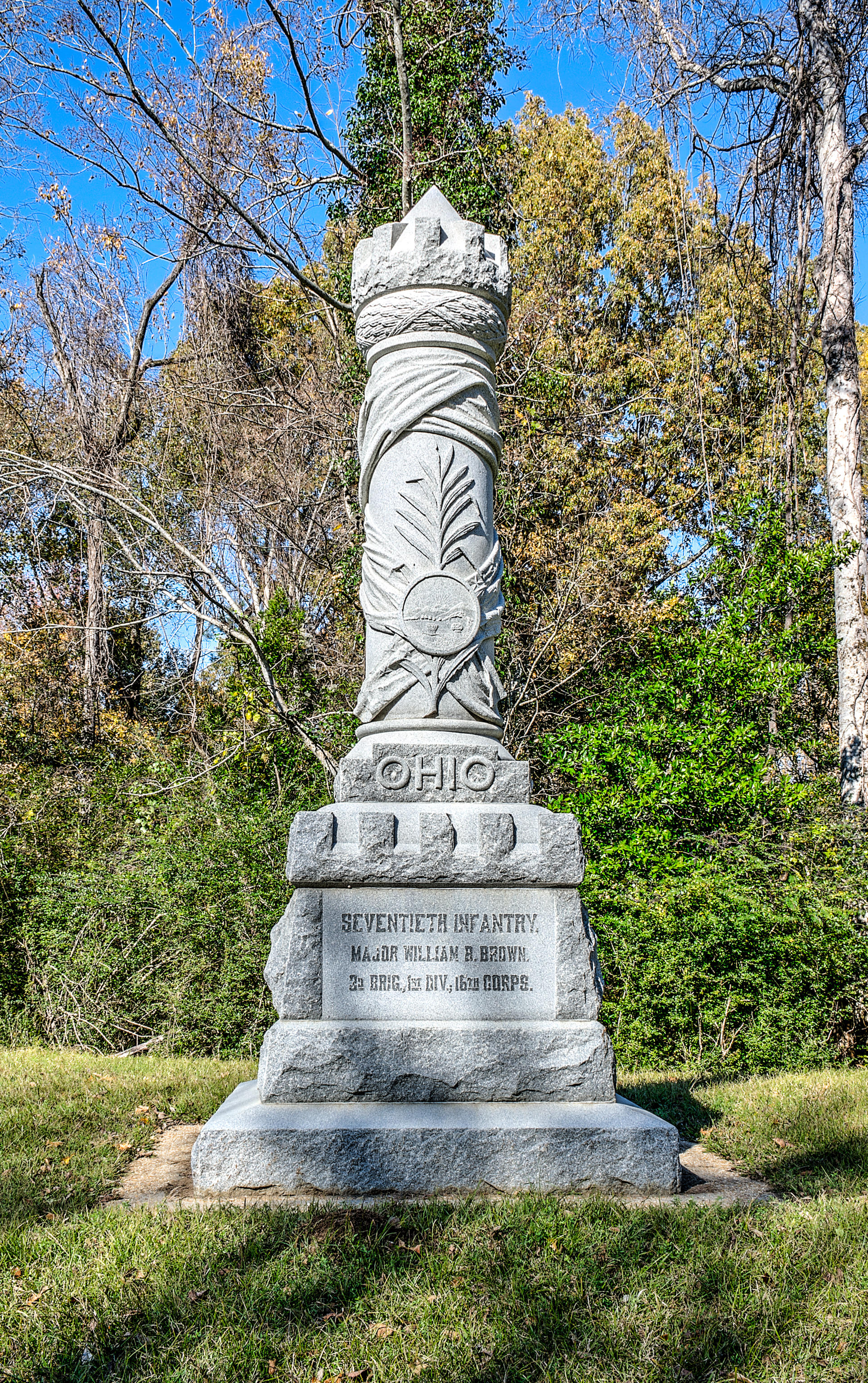
Vicksburg National Military Park: Ohio Memorial for 70th Infantry Regiment (https://upload.wikimedia.org/wikipedia/commons/0/01/22-26-287-ohio.jpg).

MT 10:20 AM -Vicksburg National Military Park: view, from bus window, of Ohio Memorial for 53rd Infantry Regiment.
.jpg)
Vicksburg National Military Park: Ohio Memorial for 53rd Infantry Brigade (known as the Minié Ball Monument due to the shape of the top of its column) (By Dsdugan - Own work, CC0, https://commons.wikimedia.org/w/index.php?curid=127013488).
“Fifty Third Infantry, Col. Wells S. Jones, 3d Brig., 1sr Div., 16th Corps.”
The Minié ball (Minie ball) was a revolutionary and deadly type of cylindrical-conical, hollow-based bullet designed by Claude-Etienne Minié in 1849. The development of the Minié bullet was significant because it was the first projectile small enough to be easily loaded into the rifled barrel of a muzzle-loading rifle. Besides enabling rapid reloading, it increased the effective range of rifles and could cause greater damage. Enfield rifled muskets, the most common weapons used during the Civil War, used the Minié ball.
.jpg)


Next, the bus stopped at the USS Cairo Gunboat and Museum.

10:48 AM -Vicksburg National Military Park: USS Cairo, side view.
One
of seven shallow-draft City Class river ironclads, the USS Cairo was
commissioned in January 1862. Named after towns along the upper Mississippi and
Ohio rivers (Cairo, Illinois in this instance), the seven formidable gunboats
prowled the Mississippi River and connecting shallow waterways, menacing
Confederate supply lines and shore batteries. They were known as the “Seven Sisters.”
The Cairo’s career was short, seeing limited action in 1862. On the morning of December 12, 1862, the Cairo’s skipper, Lt. Commander Thomas O. Selfridge led a small flotilla of gunboats into the hazardous confines of the Yazoo River, a tributary that joins the Mississippi around Vicksburg, tasked with destroying Confederate batteries and clearing the river of torpedoes (underwater mines). As the Cairo reached a point seven miles north of Vicksburg, the flotilla came under fire. The aggressive Selfridge ordered his guns to the ready and called for full steam ahead. Seconds later, the Cairo was rocked by two explosions. The first tore a gaping hole into the port (left) bow of the wooden hulled ironclad. The second detonated near the armored belt amidships on the starboard (right) side. The hole in the bow was catastrophic, and the doomed ironclad took on water. Selfridge ordered the Cairo to be beached and the crew to abandon ship. Within 12 minutes, the Cairo slid from the river bank into 36 feet of water with no loss of life. The Cairo, also known as the “Hardluck ironclad,” was the first US ship in history to be sunk by a torpedo/mine.
The Cairo’s career was short, seeing limited action in 1862. On the morning of December 12, 1862, the Cairo’s skipper, Lt. Commander Thomas O. Selfridge led a small flotilla of gunboats into the hazardous confines of the Yazoo River, a tributary that joins the Mississippi around Vicksburg, tasked with destroying Confederate batteries and clearing the river of torpedoes (underwater mines). As the Cairo reached a point seven miles north of Vicksburg, the flotilla came under fire. The aggressive Selfridge ordered his guns to the ready and called for full steam ahead. Seconds later, the Cairo was rocked by two explosions. The first tore a gaping hole into the port (left) bow of the wooden hulled ironclad. The second detonated near the armored belt amidships on the starboard (right) side. The hole in the bow was catastrophic, and the doomed ironclad took on water. Selfridge ordered the Cairo to be beached and the crew to abandon ship. Within 12 minutes, the Cairo slid from the river bank into 36 feet of water with no loss of life. The Cairo, also known as the “Hardluck ironclad,” was the first US ship in history to be sunk by a torpedo/mine.

10:49 AM -Vicksburg National Military Park: USS Cairo, view from bow (looking almost intact); this view shows more of the protective cover over the ship.

MT 10:50 AM -Vicksburg National Military Park: USS Cairo, view of port side of bow (mostly destroyed).

10:50 AM -Vicksburg National Military Park: USS Cairo, sign for "Seven Ironclads in 100 Days."
Text at top left reads as follows:
"Meet the deadline or pay $200 a day. James Eads had agreed to these terms for the construction of seven new ironclads. To speed construction, a partner shipyard built three of the boats, including the one in front of you. Eads' shipyard built the other four boats. All seven boas were delivered 100 days later."
The caption of the photo at top right reads as follows:
"Ironclads were the backbone of the brown-water navy, a fleet designed to operate in rivers and shallow coastal waters."
The caption of the small photo Eads at bottom left reads as follows:
"James B. Eads, engineer and shipyard owner, was hired to build the ironclads at an average cost of $101,808 each [just over 3 million dollars today]."
The caption of the large photo, at bottom right, reads as follows:
"The ironclads under construction in the Union Marine Works shipyard [leased by Eads] at Carondolet, Missouri." [The Cairo was built by the Mound City Marine Railway and Shipyard, near Cairo in Illinois.]

10:51 AM -Vicksburg National Military Park: USS Cairo - more of the destroyed port side, from the bow.

10:51 AM -Vicksburg National Military Park: USS Cairo - sign for "Torpedoed & Sunk"; text at top reads as follows:
" On December 12, 1862, Cairo was part of a mine-clearing expedition on the Yazoo River. Her commander, hearing small arms fire coming from up ahead, steamed around the rest of the boats and into unexplored waters. Suddenly, explosions tore holes in the boat--including the one you see in front of you. It sank quickly in 36 feet of water. No lives were lost and the crew was recovered by nearby vessels.
"What sank the USS Cairo? Some historians believe Confederates, lying in wait along the riverbank, detonated the mines (called torpedoes in the Civil War) electrically. Other experts think the underwater mines were strung on a line across the channel. When the Cairo hit the line, her forward motion pulled the torpedoes against the side of the boat where they detonated."
The caption at bottom reads as follows: "Cairo was 16 miles up the Yazoo River when she hit Confederate mines."

10:52 AM -Vicksburg National Military Park: USS Cairo - pilothouse atop the destroyed port side.

10:53 AM -Vicksburg National Military Park: USS Cairo - sign for "Pilothouse" with text that reads as follows:
"Look up. That circle of sloping iron plates overhead shielded the Cairo's pilothouse. From this exposed perch atop the upper deck, the pilot steered the gunboat and the officer on duty kept watchful eye on the river. Orders to the engine room to change speed were sent using signal boards or by shouting through a speaking tube."

10:52 AM -Vicksburg National Military Park: USS Cairo - view through interior of boat toward paddlewheel at rear.

10:53 AM -Vicksburg National Military Park: USS Cairo - capstan with view of canons in gun ports and sign for "Capstan" at right.

10:53 AM -Vicksburg National Military Park: USS Cairo - sign for "Capstan" with text that reads as follows:
"This powerful winch helped he crew haul leavy lines, move guns on the gun deck, and pull in the anchor. Steam from the boilers powered the capstan. In an emergency, this essential tool was turned by hand with wooden spokes inserted into the hub at the top."

10:53 AM -Vicksburg National Military Park: USS Cairo - sign for "A Crew of
immigrants" with text at top left that reads as follows:
"Had you stepped aboard he USS Cairo during the Civil War, the conversation may have surprised you. So many languages! Stroll the decks and you might have heard French, Danish, Russian, German, and accents from Ireland, England, and the Caribbean. Nearly half of the boat's sailors were immigrants.
"This group of men came from many walks of life. They were farmers, teachers and butchers. Most had no sailing experience. They learned their cuties on the job. U.S.-born or not, these Union sailors were fighting or the survival of the country they called home."
The list of "Personal Data" reproduced at the lower left shows where they were "Born," their "Citizen"[ship], "Age," and "Occupation."
The caption at bottom right reads as follows:
"When Cairo went down, her crew of 158 sailors and 17 officers had no time to save their personal possessions. Thousands of items sank with the boat--and were recovered during salvage operations."

10:53 AM -Vicksburg National Military Park: USS Cairo - guns on side with armor destroyed.

MT 10:54 AM -Vicksburg National Military Park: USS Cairo - Don with one of the guns on that side.

10:54 AM -Vicksburg National Military Park: USS Cairo - sign for "Full Stem Ahead!" with text at top left that reads as follows:
"Steam-driven propulsion systems like the one you see here powered riverboats churning up and down western rivers in the mid-1800s. Cairo's engines and boilers are among the oldest and best surviving examples of this type of machinery."
The drawing at top right has call-outs of "piston" at left end, "oscillating arm" in the center, and "paddlewheel" at right.
The caption for the photo of the "Piston" at bottom left reads as follows: "The steam drove two huge pistons, one on either side of the engine compartment."
The caption for the photo of the "Oscillating Arm"" at bottom right reads as follows: "The pistons pushed oscillating arms that turned the paddle wheel. At full steam, Cairo's engines could move the 888-ton gunboat at about nine miles per hour."


10:54 AM -Vicksburg National Military Park: USS Cairo - view of paddle wheel from outside open starboard side.

10:55 AM -Vicksburg National Military Park: USS Cairo - sign for "Wheelhouse" with text that reads as follows:
"The wheelhouse enclosed the paddle wheel. Wheelhouses were not armor-plated. They were vulnerable to cannon fire from batteries atop forts and along high riverbanks."
In the drawing, the "Wheelhouse" is shaded light green, and the "Latrine" is blue.
Text to the right of the drawing reads as follows:
"Water ran off the paddle wheel and into the latrine to supply a showerhead and 'flush' the commode."

10:55 AM -Vicksburg National Military Park: USS Cairo - sign for "Officers' Quarters" with text that reads as follows:
"Cairo's officers slept separately from the enlisted men. Officers' quarters were on the gun deck on either side of the paddle wheel. Here they escaped the heat from the fireroom and boilers."
The green-shaded drawing for one of the "Officers' Quarters" in connected by lines to positions along the outer walls on either side of the paddle wheel.
The blue-shaded drawing for the "Captain's Quarters" at the far right is connected by a line to the blue area showing its position.
The text below that blue drawing reads as follows: "The captain's quarters wee directly behind the paddle wheel. This part of Cairo was lost during the salvage operation."

10:56 AM -Vicksburg National Military Park: USS Cairo - view from rear toward the paddle wheel, with now-vacant area of the captain's quarters above the channel though which water from the paddlewheel exited to the rear.

10:56 AM -Vicksburg National Military Park: USS Cairo - sign for "Paddle Wheel" with text that reads as follows:
"Cairo's 15-foot-wide paddle wheel is made up of four, 22-foot-diameter 'spiders'--the web-like iron arms and circles that form the spokes of the wheel. The paddles, or 'buckets,' were probably simple wood planks. If damaged, they could be easily replaced by the boat's carpenter."
Text above the drawing reads as follows: "The paddle wheel churned within a well near the back of the boat."

10:56 AM -Vicksburg National Military Park: USS Cairo - sign for "Steering an Ironclad" with text that reads as follows:
"Rudders on either side of the paddle wheel steered the gunboat. These sturdy wooden fins were controlled by cables attached to the wheel in the pilothouse. Well-aimed enemy fire could cut the steering cables and disable the gunboat."
The small photo at the far right, captioned "Restored rudder" has a line to its position at the rear of the boat.

10:56 AM -Vicksburg National Military Park: USS Cairo - view, from the exposed front corner of the port side, toward the paddle wheel.

MT 10:59 AM -Vicksburg National Military Park: USS Cairo - other side with iron plates and guns.

10:57 AM -Vicksburg National Military Park: USS Cairo - top part of this sign, for "Plenty of Firepower," has text that reads as follows:
"Ironclads like the USS Cairo came equipped with 13 heavy cannon. It took a crew of six men to position and fire each gun. As Cairo prowled the rivers north of Vicksburg, it could use its cannon to pound Confederate forts, battle enemy gunboats, and sink shipment of supplies headed to Confederate armies."
On the drawing at the right, the color-coded key shows the different types of cannon as green for "32-pounder Navy smoothbore" (green), "42-pounder Army rifle" (red), "8-inch Navy smoothbore" (yellow), and 30-pounder Parrot rifle" (blue). A blue arrow at bottom right indicates "You Are Here."
The bottom part of this sign, for "Armor Plated," has text that reads as follows:
"Interlocking iron plates, like the ones you can see to the left of the cannon, protected the pilothouse and sloping casemates from enemy fire. Behind the 2-1//2 inch thick plates were white oak planks 12 to 25 inches thick. When the iron plates took a hit, their wooden backing kept them from shattering."
In the drawing at the right, green is for "Armor plating," and blue is for "Railroad iron." Text to the right of this drawing for "More Iron Needed" pointing to the blue portion, reads as follows: "Look to your right beyond the walkway. Cairo's crew added these iron railroad rails to protect the boat's exposed forward casemate."

10:57 AM -Vicksburg National Military Park: USS Cairo - sign for "Hog Chains" with text that reads as follows:
"Ironclad gunboats had long, flat-bottomed hulls to navigate shallow rivers. Loaded with heavy boilers, engines and guns, the hull tended to droop at the ends from uneven weight. This caused the center of the boat to hump up like a hog's back--called 'hogging.' Hog chains kept the bow and stern from sagging." The larger oval shows detail of how a "hog chain" was attached leading to the bow and stern, and the smaller oval shows the location where they were attached at the top.

10:57 AM -Vicksburg National Military Park: USS Cairo - gun mounts on bow near port side, with armor removed.

10:58 AM -Vicksburg National Military Park: USS Cairo - view of gun deck, from inside.

11:06 AM -Vicksburg National Military Park: USS Cairo - sign outside the gunboat for "The Brown Water Navy" with main text too hard to read; text box at right for "From Timberclads to Ironclads"; the main text at left is hard to read, but parts of it read as follows:
"[???] the United States Navy was faced with the daunting task of taking the Mississippi River from the Confederacy. With few ships capable [of ...ing] the shallow inland waters, necessity gave birth to the Brown Water Navy. This diverse fleet included cottonclads, timberclads, ironclads, and [???] ironclad gunboats (such as the USS Cairo) that prowled the muddy Mississippi and its many tributaries, disrupting Confederate supply lines, [...ing] fortifications, and supporting the Union Army.
"[????] came from varied segments of Northern society and enlisted for different reasons. Most were from the poor working class of Northern cities. [Some] were of foreign birth, fleeing hunger and economic turmoil. Others were the formerly enslaved seeking freedom and a new life. Regardless of backgrounds, brown water sailors served with distinction in often harsh on board conditions, making the Union victory on the Mississippi possible."
Text accompanying photos at far right reads as follows:
"USS Tyler
"Purchased by the War Department in 1861, the civilian steamer A.O. Tyler was fitted with thick oak sides, twelve cannon, and renamed the USS Tyler. It was one of the three timberclads in its first class and saw extensive action throughout the Mississippi River Valley, including the battles of Fort Donelson, Shiloh, and the Vicksburg Campaign. The 570 ton Tyler was sold at public auction in 1865."
"USS Signal
"Tinclad gunboats were river steamers protected by a thin one-inch layer of iron. Able to withstand small arms fire, they were no match for large cannons. The 190 ton Signal served throughout the Vicksburg campaign, and was lost in 1864 on the Red River."
"USS Red Rover
"The 650 ton Red Rover started life as a Confederate steamer. After capture by Union forces, it was refitted and became he US Navy's first hospital ship. With nurses, operating rooms, and modern sanitary conditions, it served the entire war on the Mississippi and was sold in 1865."
"USS Choctaw
"Pictured here off Vicksburg in 1863, the 1,020 ton Choctaw was one of the most powerful ironclads operating on the Mississippi. As a testament to its strength, it withstood over 50 strikes form Confederate cannon during the fight at Grand Gulf, Mississippi. The Choctaw was scrapped in 1866."
"USS Essex
"The imposing 640 ton ironclad Essex fought throughout the Vicksburg campaign,. After the fall of the fortress city, it continued to operate on the Mississippi. In 1865 the Essex was sold, Without armor and guns, the Essex returned to its pre-war civilian name, New Era. The New Era was sold for scrap in 1870."

11:06 AM -Vicksburg National Military Park: USS Cairo - set of three signs outside the gunboat; the following cropped versions of this photo concentrate on various parts of the signs.

11:06 AM (Cropped) -Vicksburg National Military Park: sign at left for "Seven Ironclads in 100 Days" has text at top that reads as follows:
"Meet the deadline or pay $200 a day. James Eads had agreed to these terms for the construction of seven new ironclads. To speed production, a partner shipyard built three of the boats, including the Cairo. Eads' shipyard in Saint Louis (pictured here) built the other four. All seven were delivered within 100 days."
The photo of Eads to the right of that text has a caption that reads as follows: "James B. Eads, engineer and ship yard owner, was hired to build the City Class boats at an average cost of $101,808 each."

11:06 AM (Cropped) Vicksburg National Military Park: -The bottom section below of the sign at the left is for "Andrew H. Foote (1806-1863)" with text that reads as follows:
"Foote took command of the Mississippi River flotilla in August 1861. In cooperation with the land forces of Ulysses S. Grant, he led the success[ful] assault on Fort Henry, on the Tennessee River, and was wounded in the leg during the subsequent attack on Fort Donelson while in command of the U.S.S. Saint Louis. For his success, Foote was promoted to rear admiral in July 1862.
"On February 14, 1862, Foote's gunboat flotilla steamed up the Cumberland river to exchange 'iron valentines' with the water batteries near Fort Donelson. Foote maneuvered his gunboats very close, intending to shell the Confederate batteries into submission. The cumbersome vessels, however, moved so slowly that they became easy targets for the Confederate artillerymen and were forced to withdraw.
"From a total of just under 400 rounds fired, Confederate gunners hit the St. Louis, Foote's flagship, 59 times, the Carondolet 54 times, the Louisville 36 times, and the Pittsburg 20 times."
The photo at the bottom has an inserted caption that reads as follows: "Union City Class Ironclads."

11:06 AM (Cropped) Vicksburg National Military Park: -The sign in the center is for "City Class Ironclads" with the subheading "The Seven Sisters" and text that reads as follows:
"From their first action at Forts Henry and Donelson in 1862, to the Red River Expedition of 1864, the formidable City Class gunboats provided valuable assistance to the Union campaign on the Mississippi River. Despite an 880 ton displacement, the boats drafted a mere six feet of water and it was said they 'could navigate in a heavy dew.' The Cairo is the only surviving example of the original seven City Class gunboats."
The sign then shows photos of the other six "sisters" with the following texts:
"U.S.S. Pittsburg
"Launched: October 1861 in St. Louis, Missouri
"Actions: Attack on Fort Donelson, Feb 1862. Siege of Island Number 10, March 1862. Bombardment of Fort Pillow, April 1862. Yazoo and Steele's Bayou expedition, November-December 1862. Ran past batteries at Vicksburg April 1863. Severely damaged at Grand Gulf, April 1863. Red River expedition, Mar-May 1864.
"Fate: Sold November 1865. Abandoned 1870."
"U.S.S. Saint Louis
"Launched: October 1861 in St. Louis, Missouri
"Actions: Hit 59 times and disabled during attack on Fort Donelson, Tenn, Feb 1862. Siege of Island Number 10, March 1862. Bombardment of Fort Pillow, April 1862. Battle of Memphis, June 1862. Renamed Baron de Kalb, Sep 1862. Attack on Fort Hindman, Ark., Jan 1863. Yazoo and Steele's Bayou expeditions, November-December 1862. Attack on Fort Pemberton, March 1863. Capture of Haynes Bluff, Miss., May 1863. Yazoo river expedition, May 1863.
"Fate: Sunk by torpedo in Yazoo River, May 1863.
"U.S.S. Mound City
"Launched: October 1861 in Mound City, Illinois.
"Actions: Siege of Island Number 10, March 1862. Bombardment of Fort Pillow, April 1862. Expedition on White River B[???] hit resulting in death of 103 crewmen, June 1862. Yazoo River expedition, August 1862. Steele's Bayou expedition, March 1863. Ran past Vicksburg batteries, April 1863. Red River expedition, March-May 1864.
"Fate: Sold November 1865. Scrapped 186[5].
"U.S.S. Cincinnati
"Launched: October 1861 in Mound City, Illinois.
"Actions: Attack on Fort Henry, Feb 1862. Siege of Island Number 10, March 1862. Bombardment of Fort Pillow, April 1862. Renamed and sunk during Fort Pillow. Raised and refitted. Attack on Fort Hindman, Jan 1863. Sunk by batteries at Vicksburg, May 1863. Raised and refitted, Aug. 1863. Tombigbee River, Alabama May 1865.
"Fate: Sold 1866. Sank at moorings 1866."
"U.S.S. Carondolet
"Launched: October 1961 in St. Louis, Missouri
"Actions: Attack on Fort Donelson, Tenn Feb 1862. Siege of Island Number 10, March 1862. Engaged batteries at Fort Pillow, April 1862. Battle of Memphis, June 1862. Bombardment of St. Chares, Ark June 1862. Severely damaged in engagement with CSS Arkansas on Yazoo River, July 1862. Yazoo River expedition, Dec. 1862. Ran past Vicksburg batteries, April 1863. Bombardment of Grand Gulf, April 1863. Red River expedition, Mar-May 1864.
"Fate: Sold November 1865. Hull became [Wharfboat?]."
"U.S.S. Louisville
"Launched: October 1861 in St. Louis, Missouri
"Actions: Attack on Fort Donelson, Tenn Feb 1862. Siege of Island Number 10, March 1862. Battle of Memphis, June 1862. Engagement with CSS Arkansas above Vicksburg, July 1862. Drumgould's Bluff, Yazoo River, Dec 1862. Attack on Fort Hindman, Ark Jan 1863. Steele's Bayou expedition, March 1863. Ran past Vicksburg batteries, April 1863. Bombardment of Grand Gulf, April 1863. Bombardment of Vicksburg, May-June 1863. Red River expedition, March-May 1864.
Fate: Sold November 1865."

11:06 AM Vicksburg National Military Park: -Another sign for three ships with photos and text that reads as follows:
"USS Tyler
"The Tyler served in the Western Flotilla for the entire Civil War in the West. Built in 1857 in Cincinnati, Ohio, it was active at the Bombardment of Forts Henry and Donelson, Pittsburg Landing (battle of Shiloh), and a hard-fought contest with he CSS Arkansas off Vicksburg, Mississippi in June of 1862. This converted steamer also took part in several expeditions up the mine-laden Yazoo River."
"USS Rattler
"Formerly the wooden river steamer Florence Miller, this vessel was purchased by the US Navy in 1862. She was outfitted with cannon and thin armor similar to the other "tinclads" in her class. In January of 1863, Rattler served as flagship of a flotilla of tinclads and Army transports carrying 6,000 men of General William T. Sherman's Corps during the Yazoo Pass expedition, an abortive attempt to bypass and isolate Vicksburg by means of bayous north of the city. Rattler subsequently took part in the attack on Fort Pemberton, the Red river campaign, and raids up the Black, Tensa, and Ovachita rivers. In September 1863, her commanding officer and sixteen crew were captured while ashore attending church in Rodney, Mississippi. The ill-fated Rattler sank during a storm in December, 1864."
"USS Tuscumbia
"The USS Tuscumbia was built in 1862 in Cincinnati, Ohio, and commissioned at Cairo, Illinois, after in April, 1873, she carried Admiral David D. Porter and Generals Ulysses S. Grant and William Tecumseh Sherman on a reconnaissance expedition up the Yazoo River to determine the practicality of landing a force above Vicksburg at Hayne's Bluff. Tuscumbia withdrew under heavy fire from Confederate shore batteries, prompting the decision to sift operations below Vicksburg to Grand Gulf. Tuscumbia participated in the run past the Vicksburg batteries on the night of 16 April and 17 April 1863, towing the damaged transport Forest Queen to safety. On 20 April, Tuscumbia reconnoitered the Mississippi from New Carthage to Grand Gulf and took part in the attack on the Confederate works at Grand Gulf on 29 April. During the attack, Tuscumbia suffered five casualties and was put out of action after taking 81 hits. She was quickly repaired and bombarded Vicksburg batteries on 19 May and 22 May. During the attack on the 22nd, Benton, Mound City, Carondolet, and Tuscumbia silenced three water batteries and destroyed four guns. She was ordered to Memphis in May 1864 and assigned patrol duty between Cairo and the head of the Tennessee River. Tuscumbia survived the war and was sold at auction in November 1865."

11:07 AM Vicksburg National Military Park: - sign, just across the road from USS Cairo, for "Final Resting Place With Dignity" with main text at top left that reads as follows:
"Gaining control of Vicksburg and the Mississippi River cost so many lives--more than 10,000 Union dead. In the aftermath of battle, the dead were often buried hastily in makeshift graves. At hundreds of Civil War battle sites the remains of fallen soldiers lay nearly forgotten, scattered in woods, fields, and roadside ditches.
"National cemeteries were created in 1862 to provide a remedy, proper and honorable burials for the men who died in service. Established in 1866, Vicksburg National Cemetery holds the remains of 17,000 Union servicemen--more than any other national cemetery--and about 1,000 veterans of other U.S. conflicts."
Caption in bottom right corner of photo at left reads as follows: " Officer's Circle, 1940 Postcard."
Text over photo at top right reads as follows:
"To Honor and Remember
"At the close of he Civil War, the federal government conducted a massive search for the temporary graves of Union soldiers and sailors. The remains of nearly 300,000 men were eventually reburied in national cemeteries. Many have never been identified--their graves marked by simple square blocks."
The caption below the photo reads as follows: "Soldiers prepare bodies for burial."
Text beside the photo at bottom right reads as follows:
"National cemeteries were initially for Union burials only. The remains of about 5,000 Confederate veterans who died at Vicksburg lie in Cedar Hill Cemetery, in an area called 'Soldiers Rest.' "
The inscription on base of the statue at bottom right reads, in part: "Confederate ...."
Recognizing
the need to address the proper burial of Civil War dead, Congress passed
legislation to establish Vicksburg National Cemetery in 1866, The
following year internments began at the cemetery. More than 17,000 troops are
buried there, the largest Union cemetery in the nation. Of these burials, the
identity of almost 13,000 soldiers and sailors are unknown. The cemetery also
protects the final resting place of a significant number of United States
Colored Troops that served with distinction in the Civil War. The time period
for Civil War internments was 1866 to 1874. This national cemetery also
contains the remains of veterans of the Mexican-American War, Spanish-American
War, the First and Second World Wars, and the Korean War. It was closed to
burials in 1961.
Many Confederates who died in the Siege of Vicksburg are buried in a section of the nearby Cedar Hill Cemetery known as “Soldiers’ Rest.” This burial site contains the graves of some 5,000 Confederate soldiers, with 1,600 identified.
Many Confederates who died in the Siege of Vicksburg are buried in a section of the nearby Cedar Hill Cemetery known as “Soldiers’ Rest.” This burial site contains the graves of some 5,000 Confederate soldiers, with 1,600 identified.